
21s: THE FORGOTTEN METHOD OF OLD-SCHOOL STRENGTH


AKA: How "Big" Jim Williams Became the First Man to Bench Press 700 lbs
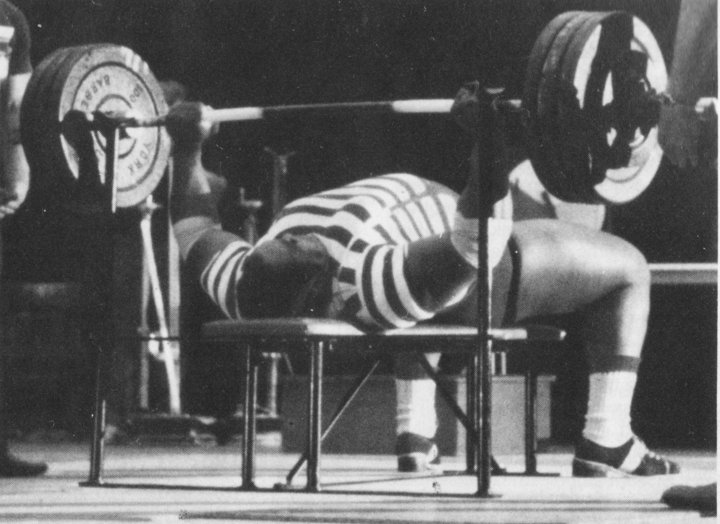
Big Jim Williams bench pressing in competition.

 I rarely think about, or plan at all, what I'm going to write on this blog until I actually sit down to write it. Now, don't get me wrong, I don't write everything in this manner.  Currently, for instance, I'm working on a "Budo Zen" book on the real intersection of martial arts and spirituality, and that book takes research.  But that aside, I really, truly have no idea what I'm going to write until I sit down and actually, you know, write it.


So this morning I sat down to hammer away at my keyboard, and thought, "what the heck should I write about in the field of strength training that I haven't written about, or, at least, haven't written about in a long time?"  About the only planning I do is asking myself that sort of question once I decide whether I want to write about muscle-building, or serious strength training, or classical budo.  And for some reason, only one thing popped in my head today: the old-school powerlifter "Big" Jim Williams, and his almost completely forgotten method of strength-building that allowed him to be the first man to bench press 700 pounds.


Don't know who Jim Williams is?  Good.  You're in for a treat.


Big Jim Williams—born James Talbot Williams in 1940 in Scranton Pennsylvania—was known by several other nicknames throughout his illustrious powerlifting career.  These included the King of the Bench Press, the Scranton Superman, and the Big Black Bear of Scranton, because, yes, the man looked like a colossal black bear.


According to Charles Poliquin, in an article entitled "A Perspective on the Bench Press" at charlespoliquin.com:

Born in Scranton, Pennsylvania, Williams was exceptional in size and strength from a young age. By the time he was 12 years old, he weighed 200 pounds and excelled in both football and track and field. Williams reached the state finals in the shot put four times, ultimately winning once. Even when he weighed 340 pounds, he was capable of dunking a basketball.

If that's true, well, that's more than just a little impressive, and it gives you an understanding of what this man was not just capable of, but eventually achieved.

In his youth, apparently Williams became involved with criminal activity, and he was sentenced to ten years in prison when he was 21 years old for assault, battery, and "strong-arm" robbery.  But prison proved to actually be a life-saver for him, as it was in prison that he took up serious weight training.

Released from prison, it wasn't too long before he became a phenom in the world of powerlifting, along with, it must be said, his training partner Jon Kuc.  His initial goal was to break the bench press record of Pat Casey, the first man to bench press over 600 pounds—Casey's world record stood at 615.  In 1969, Williams became the 2nd man to ever bench press 600.  And in 1971, at the Eastern US Open, he benched 635 lbs for a new world record.  Then, in the same year, he benched 660 at the AAU.  Eventually, he would bench 675 lbs in competition.  But here's the thing: there was no "equipped" lifting back then, and absolutely nothing "state-of-the-art" to help a bench presser.  Williams wore only a t-shirt and a singlet, with light ACE bandages (that were NOT long).  The bandages were more to help prevent injury, and did nothing to actually increase a lifter's number in the bench press.  Although it wasn't an "official lift," he eventually bench pressed 720 in the gym, which was witnessed by Kuc and three international judges.  Another thing that must be noted is that all of his competition lifts were done with a 2-second pause on the chest, a requirement in competition at the time.

Williams was more than just a bench presser, as he also squatted 900 pounds, and deadlifted over 800, even though he was not at a "mechanical advantage" for the deadlift.

As impressive as his feats of strength were—and they were, and still are, damn impressive—it's his strength training methodology that I want to focus on here, and his particular method of training that he called "21s."  (And just so there's no confusion, this method of 21s has nothing to do with the bodybuilding method of 21s where you do 7 half reps from the top of the lift, 7 from the bottom, and then 7 full reps.  This is completely different.)

The 21 Method of Strength and Power

Here's how real 21s work: On your major lifts (squats, benches, deadlifts, overhead presses - whatever lift it is that you're trying to get stronger) you perform no more than 21 total reps for that lift in the workout. Using this technique, you then train the lift rather frequently. Anywhere between 3 to 5 days per lift, for instance. (On deadlifts you might want to do less; the muscles of the lower back simply take longer to recover for most lifters.)

Let's say that you have a max squat that hovers somewhere in the 400 pound range. Using 21s your workout might go like this: 135 for 5 reps, 225 for 5 reps, 275 for 5 reps, 315 for 3 reps, 375 for 2 reps, 400 for 1 single. You then repeat this workout another 2 to 3 days during the week. Because the volume is so low on the lift—in comparison to your strength level—your body can handle the frequent training. Slowly increase the weight over the course of a few weeks, and before you know it your squat is better than ever.

Here is what a week of training might look like for a powerlifter trying to increase all his/her 3 lifts:

Monday: Squats: 21 reps, Bench Presses: 21 reps, chins for 5 sets of 5 reps, lying dumbbell triceps extensions for 3 sets of 10 reps

Tuesday: Bench Presses: 21 reps, Deadlifts: 21 reps

Wednesday: Squats: 21 reps, barbell curls for 3 sets of 10 reps, front plate raises for 3 sets of 10 reps

Thursday: Deadlifts: 21 reps, Bench Presses: 21 reps, bench dips for 2 sets of 20 reps

Friday: Squats: 21 reps

Saturday: Bench Presses: 21 reps


It's a shame you don't see more of this kind of lifting performed nowadays. Maybe it's not very popular because it's just too straightforward and basic. There's nothing glamorous about it, that's for sure. Of course, there was nothing glamorous about Jim Williams either, just a heaping mountain of mass and might.

The Scranton Superman died in 2007 at the age of 66.  Even though that's not that long ago, his training methods have faded into a memory from the distant past.  Maybe it's time to revive them.

Comments

  1. Of course, this is chapter “21” in the next book….

    ReplyDelete

Post a Comment

Feel free to leave us some feedback on the article or any topics you would like us to cover in the future! Much Appreciated!

Popular posts from this blog

2-Way Training Splits for Mass & Power

The Best Two-Way Training Splits for Inducing Hypertrophy and Unleashing Impressive Gains in Strength      I’m fond of full-body workouts.   In fact, if you’re new to training, and you stumbled upon this essay as you scoured the internet looking for the best split program to make you massive—not to mention massively strong—then understand that you’re better off utilizing full-body workouts.   At least at the start.   Eventually, you will want to move on to a split program of some sort, however.   Now, please don’t get me wrong (I mean, really, don’t), you could spend your entire training life doing nothing other than full-body workouts —whether they’re high-frequency “easy strength” programs, or heavy/light/medium programs, or just “basic” 3 day a week programs where all of the training is “ moderate ”—and never need anything else.   But eventually you’ll want to use some split programs, even if it’s just occasionally, and even if it’s don...

Bill Starr’s Midlife Muscle Builder

Advice from Bill Starr (and Myself) for the Midlife Bodybuilders and Lifters      Last week, I overdid it.  I should know better.  Actually, I do know better.  But, like all former elite athletes I’ve ever met with decades of training under their lifting belts, there are workouts and weeks when I decide to do a little too much—train too heavy, do cardio that is  way too intense—if nothing than to see if I can still handle it.  Kinda stupid, I know.  But I still do it.  And every time that I do this, reality comes crashing back down to earth and I know I need to settle into a kinder, gentler training routine.  How do I know I overdid it?  Because I hurt like hell in my joints and pretty much want to take a nap all day long instead of staring at this computer screen and writing the very thing that you’re now reading.      If you’re in your 40s and 50s, and have trained for a considerable amo...

Classic Bodybuilding: Serge Nubret's "Chase the Pump" Training

For those of you who are my age or older, you can probably remember well the first time you saw the amazing physique of Serge Nubret: It was in the pseudo-documentary we all now know and love as “Pumping Iron.”  With the director and writers of Pumping Iron attempting to make out the film as a “David vs Goliath” with the young (but massive) Lou Ferrigno taking on the older “Goliath” in the form of Arnold Schwarzenegger, they had no idea that their whole half-true enterprise would crumble a bit with the entry of Serge Nubret. You took one look at Nubret and you knew there was no doubt that Ferrigno was out of his league with both Schwarzenegger and the Frenchmen.  (Nubret was French.) Nubret - to this day - had one of the most classically beautiful physiques of all-time.  Arnold, of course, won the whole thing, but Nubret easily came in 2nd. By the time I watched Pumping Iron sometime in the mid to late ‘80s, there was very little information that I could fin...