Some Training Ideas for Outdoor Fall Lifting Using Loaded Carries and Odd Lifts
I have written before that my favorite time of the year to train is the Fall season. In fact, last year, around this exact same time, I wrote a piece on Fall training that was mainly centered around sandbag workouts. In this essay, I want to do something a little different by giving you some different and varied training ideas for outdoor lifting using loaded carries and other “odd” lifts.
For the first time this year, it’s starting to get a little cool here in central Alabama where I live. And when coolness sets in, I like to take some training implements and objects from my garage to the yard, where I can lift, carry, drag, flip, or push them in assorted ways.
Last night, after completing a full-body workout consisting of front squats, kettlebell cleans, bench presses, chins, and barbell curls—a pretty good workout in itself—I decided to do something that my girlfriend, Kandy, called “crazy.” During a storm last week, a hickory tree fell on my property at the bottom of a very steep hill, so I decided to cut a 20-foot piece of it and see if I could drag it up the hill. “I don’t think that’s possible,” Kandy said. “It’s just going to be too difficult.”
Difficult is what I wanted. Although I’m a fan of “moderate” and “sensible” workouts as much as hard-as-hell ones, sometimes the body needs a challenge. I wanted to attempt this challenge just to see if I could do it. To be honest, I wasn’t sure I could get it up the hill, but I didn’t tell my girlfriend that. In fact, I told her I was going to get it up the hill no matter how damn long it took, come hell or high water, which forced me to commit to doing it. (It took me about an hour, by the way, although that did include cutting it with a handsaw.)
At first, I attempted to drag it up the hill by tying a rope to it. I knew this would be harder than simply trying to pick it up and carry it because it digs into the ground the further it’s dragged. I managed to get it about a quarter of the way up by dragging it as seen here:
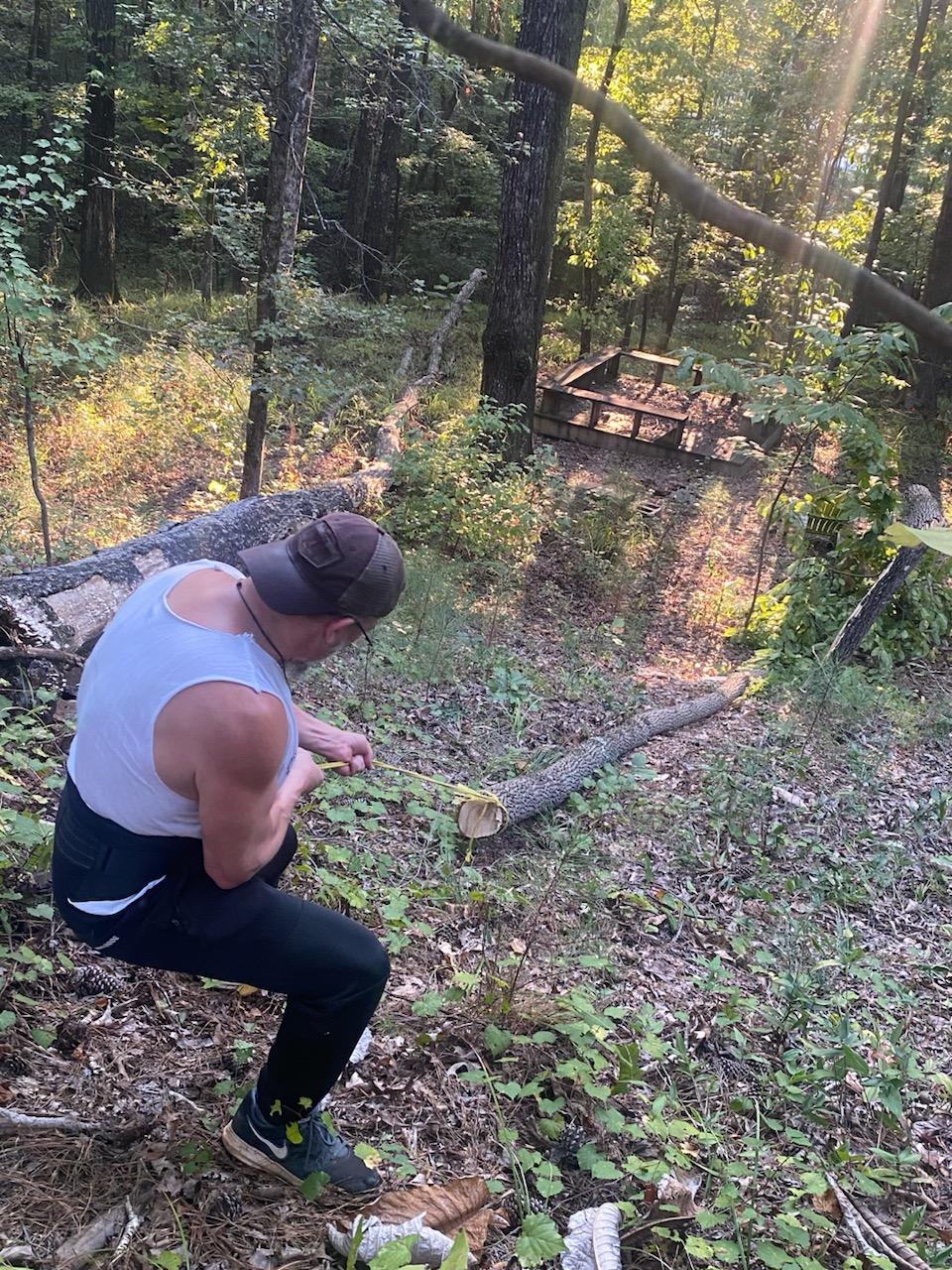 |
| When I started dragging this, it was next to my deck at the bottom of the hill. |
By the time I got to the point seen in the picture, I could barely budge it, so I then decided to just pick it up and carry it the rest of the way as seen in this shot:

When I got it to the top, all of my muscles were on fire, and I was exhausted to the point of almost collapsing. My forearms and hands were raw and bleeding. It felt great. I then took a shower, ate a large meal, and drank a few cold beers. (Beer never tasted so good!) Oh, and I also slept like a baby.
You don’t want to do that kind of thing on a daily basis but once—maybe twice depending on your other training—a week can be beneficial. What follows are some different workout ideas you might want to try. They may not be log lifting up an incline, but they’re still pretty challenging. Do these at the end of a training session, or as individual workouts on separate days.
One Exercise, One Hour
Sometimes, I do a training program where I just pick one lift to train each day, and then train that lift for an hour straight. I’ve had folks tell me that one exercise doesn’t seem as if it’s enough. Really? Try squatting for an hour straight—doing a set every few minutes, high reps or low reps, doesn’t matter—and then get back to me about how “easy” that workout is.
This is also a great way to train carries. Pick either farmer walks, sandbag carries, or stone carries. Do one set for a certain distance. Make sure it’s not too hard; don’t go “all out” or there’s no way you’ll be able to complete the workout—or if you do complete it, you may not be able to train again at all for several days. After that first set, rest four or five minutes, and then repeat. You should end up doing around 10 to 15 sets for the entire hour.
The 50% Technique
Here’s another good way to train loaded carries or dragging movements while managing fatigue. Do a hard set for distance of any exercise. Don’t go to failure but come close. When you are finished, rest a few minutes, and repeat. But only go for half the distance. After a few minutes of rest, repeat another half-distance carry. After that, once again do the same distance as the first set. Repeat in this manner for however many sets you want to do. If you really want to challenge yourself, keep doing sets of the “full distance” until you can no longer get the same distance on those sets.
You Go, I Go
Here’s a “classic” method of training that’s great if you have a partner. Once again, pick any carrying, dragging, or other “odd” lift movement. Do a hard set, but not to failure. If you don’t leave a little something “in the tank” after each set, you won’t be able to do this for long. Once you’re finished with your set, your training partner immediately does the same lift for the same distance. When he/she is finished, then you immediately go again. Continue in this manner until fatigue starts to really set in.
The Tri-Set Challenge
For this one, you’ll need three different objects to drag, carry, or flip. I often use sandbag carries, sled drags, and farmer walks, done in that order. Line up each object next to one another. Do a set of the first movement. Make it hard, but once again, not all out. As soon as you’re finished, walk slowly back to the second object(s). Carry or drag it for the same distance as the first. And as soon as you’re done with that one, walk back to the starting point and drag or carry the last implement. Rest a few minutes and repeat. Other good lifts would be stone carries, keg carries, tire flips, or, yep, even log drags or carries.
Carry and Deadlift
Here’s a good one for either farmer walks or sandbag carries. Do a set for about half of the distance of a really hard set. At that point, without setting down the ‘bells or sandbag, deadlift them/it for a certain number of reps. As with the carrying portion, don’t go all-out on the deadlifts. As soon as you finish your set of deadlifts—don’t set down the weight—carry the weight back to your starting point. When you get to the “finish line,” do another set of deadlifts for the same number of reps as the first set. Rest a few minutes and repeat as many times as you want.
I hope this short article has given you some ideas for outdoor training. It’s Fall now, so get outside and do them!
Comments
Post a Comment
Feel free to leave us some feedback on the article or any topics you would like us to cover in the future! Much Appreciated!