
21s: THE FORGOTTEN METHOD OF OLD-SCHOOL STRENGTH


AKA: How "Big" Jim Williams Became the First Man to Bench Press 700 lbs
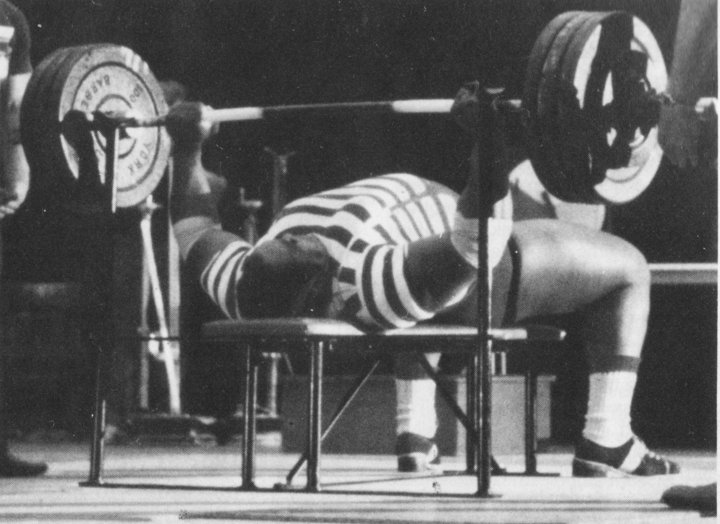
Big Jim Williams bench pressing in competition.

 I rarely think about, or plan at all, what I'm going to write on this blog until I actually sit down to write it. Now, don't get me wrong, I don't write everything in this manner.  Currently, for instance, I'm working on a "Budo Zen" book on the real intersection of martial arts and spirituality, and that book takes research.  But that aside, I really, truly have no idea what I'm going to write until I sit down and actually, you know, write it.


So this morning I sat down to hammer away at my keyboard, and thought, "what the heck should I write about in the field of strength training that I haven't written about, or, at least, haven't written about in a long time?"  About the only planning I do is asking myself that sort of question once I decide whether I want to write about muscle-building, or serious strength training, or classical budo.  And for some reason, only one thing popped in my head today: the old-school powerlifter "Big" Jim Williams, and his almost completely forgotten method of strength-building that allowed him to be the first man to bench press 700 pounds.


Don't know who Jim Williams is?  Good.  You're in for a treat.


Big Jim Williams—born James Talbot Williams in 1940 in Scranton Pennsylvania—was known by several other nicknames throughout his illustrious powerlifting career.  These included the King of the Bench Press, the Scranton Superman, and the Big Black Bear of Scranton, because, yes, the man looked like a colossal black bear.


According to Charles Poliquin, in an article entitled "A Perspective on the Bench Press" at charlespoliquin.com:

Born in Scranton, Pennsylvania, Williams was exceptional in size and strength from a young age. By the time he was 12 years old, he weighed 200 pounds and excelled in both football and track and field. Williams reached the state finals in the shot put four times, ultimately winning once. Even when he weighed 340 pounds, he was capable of dunking a basketball.

If that's true, well, that's more than just a little impressive, and it gives you an understanding of what this man was not just capable of, but eventually achieved.

In his youth, apparently Williams became involved with criminal activity, and he was sentenced to ten years in prison when he was 21 years old for assault, battery, and "strong-arm" robbery.  But prison proved to actually be a life-saver for him, as it was in prison that he took up serious weight training.

Released from prison, it wasn't too long before he became a phenom in the world of powerlifting, along with, it must be said, his training partner Jon Kuc.  His initial goal was to break the bench press record of Pat Casey, the first man to bench press over 600 pounds—Casey's world record stood at 615.  In 1969, Williams became the 2nd man to ever bench press 600.  And in 1971, at the Eastern US Open, he benched 635 lbs for a new world record.  Then, in the same year, he benched 660 at the AAU.  Eventually, he would bench 675 lbs in competition.  But here's the thing: there was no "equipped" lifting back then, and absolutely nothing "state-of-the-art" to help a bench presser.  Williams wore only a t-shirt and a singlet, with light ACE bandages (that were NOT long).  The bandages were more to help prevent injury, and did nothing to actually increase a lifter's number in the bench press.  Although it wasn't an "official lift," he eventually bench pressed 720 in the gym, which was witnessed by Kuc and three international judges.  Another thing that must be noted is that all of his competition lifts were done with a 2-second pause on the chest, a requirement in competition at the time.

Williams was more than just a bench presser, as he also squatted 900 pounds, and deadlifted over 800, even though he was not at a "mechanical advantage" for the deadlift.

As impressive as his feats of strength were—and they were, and still are, damn impressive—it's his strength training methodology that I want to focus on here, and his particular method of training that he called "21s."  (And just so there's no confusion, this method of 21s has nothing to do with the bodybuilding method of 21s where you do 7 half reps from the top of the lift, 7 from the bottom, and then 7 full reps.  This is completely different.)

The 21 Method of Strength and Power

Here's how real 21s work: On your major lifts (squats, benches, deadlifts, overhead presses - whatever lift it is that you're trying to get stronger) you perform no more than 21 total reps for that lift in the workout. Using this technique, you then train the lift rather frequently. Anywhere between 3 to 5 days per lift, for instance. (On deadlifts you might want to do less; the muscles of the lower back simply take longer to recover for most lifters.)

Let's say that you have a max squat that hovers somewhere in the 400 pound range. Using 21s your workout might go like this: 135 for 5 reps, 225 for 5 reps, 275 for 5 reps, 315 for 3 reps, 375 for 2 reps, 400 for 1 single. You then repeat this workout another 2 to 3 days during the week. Because the volume is so low on the lift—in comparison to your strength level—your body can handle the frequent training. Slowly increase the weight over the course of a few weeks, and before you know it your squat is better than ever.

Here is what a week of training might look like for a powerlifter trying to increase all his/her 3 lifts:

Monday: Squats: 21 reps, Bench Presses: 21 reps, chins for 5 sets of 5 reps, lying dumbbell triceps extensions for 3 sets of 10 reps

Tuesday: Bench Presses: 21 reps, Deadlifts: 21 reps

Wednesday: Squats: 21 reps, barbell curls for 3 sets of 10 reps, front plate raises for 3 sets of 10 reps

Thursday: Deadlifts: 21 reps, Bench Presses: 21 reps, bench dips for 2 sets of 20 reps

Friday: Squats: 21 reps

Saturday: Bench Presses: 21 reps


It's a shame you don't see more of this kind of lifting performed nowadays. Maybe it's not very popular because it's just too straightforward and basic. There's nothing glamorous about it, that's for sure. Of course, there was nothing glamorous about Jim Williams either, just a heaping mountain of mass and might.

The Scranton Superman died in 2007 at the age of 66.  Even though that's not that long ago, his training methods have faded into a memory from the distant past.  Maybe it's time to revive them.

Comments

  1. Of course, this is chapter “21” in the next book….

    ReplyDelete

Post a Comment

Feel free to leave us some feedback on the article or any topics you would like us to cover in the future! Much Appreciated!

Popular posts from this blog

Marvin Eder’s Mass-Building Methods

  The Many and Varied Mass-Building Methods of Power Bodybuilding’s G.O.A.T. Eder as he appeared in my article "Full Body Workouts" for IronMan  magazine.      In many ways, the essay you are now reading is the one that has had the “longest time coming.”  I have no clue why it has taken me this long to write an article specifically on Marvin Eder, especially considering the fact that I have long considered him the greatest bodybuilder cum strength athlete of all friggin’ time .  In fact, over 20 years ago, I wrote this in the pages of IronMan magazine: In my opinion, the greatest all-around bodybuilder, powerlifter and strength athlete ever to walk the planet, Eder had 19-inch arms at a bodyweight of 198. He could bench 510, squat 550 for 10 reps and do a barbell press with 365. He was reported to have achieved the amazing feat of cranking out 1,000 dips in only 17 minutes. Imagine doing a dip a second for 17 minutes. As Gene Mozee once put ...

High-Frequency Wave Load Training

A Highly Effective High-Frequency Program for Strength, Power, and Muscle Mass      In several recent articles, I have presented a few key concepts to building strength, power, and muscle mass.  One of the concepts is the “90% method” where you do most of your sets at 90% of a certain rep range.  It could be 90% of 1 rep, of 3 reps, of 5 reps, or even as high as 10 reps.  (If you want more in depth discussion on the 90% method then read my article “ Skill Training as Size Building .”)  I have also presented the concepts of weight ladders and wave loading , where, instead of sticking with the same weight throughout several sets before moving to a different weight, you move back and forth from heavier to lighter sets.      One of my more popular recent articles that used the above concepts is “ The 1-5 Program .”  It’s a high-volume program.  It’s good for lifters who like to use split programs, as it’s a mul...

Mass on Demand - The 5x10 Workout

The 5x10 Workout Program      The longer that I have been training and working with other lifters, the more that I believe that simple, though not necessarily easy, programs are the best methods to use.  I think this is the case for the majority of lifters.  There are times when this is not so, but that’s usually for either elite athletes or programs for strength athletes at the top of powerlifting or Olympic weightlifting.      In my last article on different ways that you can incorporate heavy, light, and medium workouts into your training, I mentioned a few ways that this can be done.  One of them is to keep your weights the same at each workout session but rotate the sets and/or reps.  This is in direct contradiction to the most popular method of H-L-M, Bill Starr’s 5x5 training, where you keep the sets and reps the same (5x5) but rotate the amount of weight used on the lifts.  The program here uses the firs...