Double-Split
Training, Part Two
Understanding Why Double-Split Training is Effective
Here’s a cool thing about double-split
training: there’s an endless amount of variety that you have at your disposal
when it comes to double-split workouts.
In fact, however-the-heck it is that you like to train, you can make
your training a bit more effective by turning all of those workouts into
double-split programs.
Do you like to train each bodypart
once-per-week, by training one bodypart-per-day, and blasting the living hell
out of it, then giving it a week to recover? (As I’ve written many times before, this was a very
effective training system that I used to pack on pounds of muscle when I was
much younger.) If that’s your cup
of tea, no problem, here’s what your double-split program could look like:
Mondays: Chest
Tuesdays: Back
Wednesdays: Legs (quads and
hamstrings)
Thursdays: Shoulders
Fridays: Arms and calves
And here’s what your Monday workouts would
look like:
Workout One: Flat Barbell Bench
Presses for 10 sets of 8 reps
Workout Two: Incline Dumbbell
Presses for 4 sets of 12 reps, Wide-Grip Dips for 3 sets of 10 reps, and
Incline Dumbbell Flyes for 3 sets of 10 reps
Do the second workout about 4 hours after
your first workout (so that soreness has yet to set in from all of the flat
bench presses) and you should be on your path to an effective once-per-week
program.
All of your other workouts should be of a
very similar variety, and as long as you’re optimizing your peri-workout
nutrition for both training sessions, you should have no problem gaining plenty
of muscle on just such a program.
Okay, here are some quotes from several
other bodybuilders/writers/strength trainers, and their thoughts about
double-split workouts. As you can see,
I’m not crazy for recommending such frequent training. It’s been used by others for quite some
time in the bodybuilding world.
And, besides just bodybuilding, Olympic lifters have used such training
methods for decades.
The first quote is from John Meadows, a
popular bodybuilding writer (and bodybuilder in his own right):
If you don’t like being in the gym, this
program isn’t for you. On the other hand, if you’re a true M&Fer, you can’t
wait to get back in there after every session. Sometimes you even wish you
could go back sooner. If this is your attitude, or you’re a college student
with an open class schedule or a guy who’s currently between jobs and must vent
his frustrations by lifting as much heavy iron as often as possible, two-a-days
are exactly what you need.
Training twice a day is a concept as old
as bodybuilding itself but was popularized by Arnold more than anyone. He
firmly believed his “double-split system” allowed him to separate himself from
the pack and win his first Mr. Universe title. His rivals criticized it, saying
it was too much training, and to their point, two-a-days have run many a lifter
into the ground. But applied scientifically, there may be no better method for
making big gains in a short period.
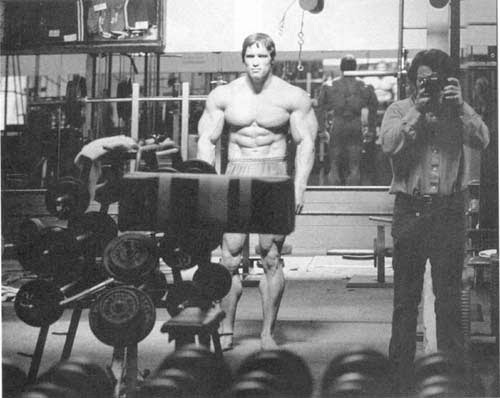 |
| Double-split training was obviously effective for Arnold |
The reason is frequency. Provided you can
recover from each session, the more often you train a body part, the faster you
can deliver a growth stimulus and the sooner your muscles will respond. Training your chest so
hard that it takes a whole week to recover before you can hit it again isn’t as
effective as hitting it light one day and then hard three days later. That’s
two chest-building workouts in one week, so you essentially double the
stimulus.[1]
And here’s what another popular
bodybuilding writer, Christian Thibaudeau, has to say about the way that
European bodybuilders often train.
I personally find these insights the most interesting:
The more you're involved in the world
of strength training, the more you get to meet interesting people and learn new
training methods. Last year I attended the Weider International Grand Prix of
Canada, a bodybuilding contest organized by the Quebec Federation that included
several of the world's best amateur bodybuilders from the Czech Republic, Slovakia,
France, Poland, etc.
What's interesting is that these
countries aren't under the same influence as North American lifters. They
haven't been contaminated by muscle rag propaganda. Rather, their methods are
heavily influenced by the training of their Olympic lifters and powerlifters.
In some cases, athletes from all three sports train together and some even
compete in two or all three of these events!
So when you get to know these
guys and learn how they train, you realize there’s more than one way to get
big, and you don’t need to follow the 3 x 10 dogma to do it!
Needless to say, these guys know how to
train for size. But exactly what are they doing? The following will explain
their training system and how it can be adapted to fit the North American
lifestyle.
Principle #1:
Intensification/Accumulation Split Training
These athletes have two training sessions
per day (on the days they train). The morning session is a high load workout,
while the early evening (or afternoon) session is an "intensive"
workout.
Don't confuse "intensive" with
intensity strength training jargon. Intensity normally refers to the weight
used (e.g. an intensity of 90% of your 1RM). Intensive means the use of advanced
intensity techniques such as supersets, drop sets, forced reps, etc.
The heavy session is performed first when
the CNS is fresh and ready to go. That's a very important point. At least 4-6
hours separate both workouts to allow the athlete enough time to use restorative
measures and ingest two or three meals.
Principle #2: Mornings Are
For Strength
In the morning session, train for
strength. East European countries have a large background of Olympic lifting
and this is reflected in the training of their bodybuilders. The bodybuilding coaches
(they do have a national coach and a whole organized coaching system for their
top athletes) were often old Olympic lifters. The same could be said about some
of their athletes.
While they don't perform the Olympic lifts
in their first session, they do employ an Olympic lifting mentality of using
few movements (two or three) performed for a lot of sets of few reps, normally
above 85% of the athlete’s maximum. This training session serves several
purposes:
• It greatly increases muscle density and
hardness (myogenic tone or "tonus").
• It can enhance neural efficiency,
especially the capacity to recruit high threshold motor units. This means that
subsequent bodybuilding-type training will be more effective since the body now
has the capacity to recruit more muscle fibers.
• It can increase muscle size in its own
right.
Principle #3: Evenings Are
For "The Pump"
In the early evening session, train for
"the pump." Well, the objective isn't the pump per se; it simply
means that in the second workout of the day, the methods used are high-volume
and high-density (a lot of work performed per unit of time).
Rest intervals are kept as short as
possible and density training techniques such as supersets, pre-fatigue,
post-fatigue and drop sets are used, as well as intensity techniques such as
slow eccentrics, isometrics combined with regular reps and forced reps.[2]
If you're interested in some advanced sessions for double-split training, stay tuned. I will present some more training plans in upcoming posts. Until then, if you decide to use double-split workouts, good luck and good training.
Comments
Post a Comment
Feel free to leave us some feedback on the article or any topics you would like us to cover in the future! Much Appreciated!